Comparative analysis of concrete strength utilizing quarry crushed and locally sourced coarse aggregates in Jos metropolis
Keywords:
Concretes, Compressive strength, Aggregate crushing value, Los Angeles abrasion, Aggregate impact valueAbstract
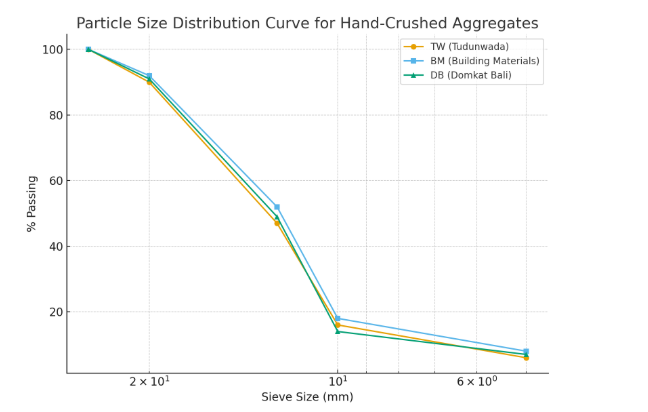
This work compares the compressive strength and other physical properties of concrete made with coarse aggregates obtained from machine-crushed and hand-crushed coarse aggregates improvised from Jos Metropolis middlebelt Plateau State Nigeria. The phenomenon of using nonconforming hand-crushed aggregates in local construction which provides variable concrete quality through batching inevitably invalidating structural integrity galvanized the research. Aggregates from three machine crushed sources PW Quarry (Jos South), RicRock Quarry (Jos East) and Moulds Quarry (Jos East) and hand-crushed source: Tudunwada (TW), Building Materials Market (BM) and Domkat Bali (DB). Test were conducted on the rock samples to determine their geological, physical and mechanical properties in accordance with BS 410, BS 812 and BS EN 12520 respectively. The results of sieve analysis shows that machine-crushed aggregates has a 95-95% the 20 mm sieve and 54-58% passing the 12.5 mm sieve which are within the BS EN 12620 grading limit, while the hand-crushed aggregates exhibited below the stipulated gradation. The mechanical properties of the machine-crushed aggregates revealed that LAA ranges from 21.6-23.4%, AIV of 17.5-18.9% and ACV of 19.2-20.4% across all the samples indicating a higher resistance to wear confirming better mechanical performance against the hand-crushed aggregates with LAA of 26.8-28.5%, AIV of 21.7-23.1% and ACV of 23.4-24.9% which are higher and may result to poor concrete bonding. The compressive strength showed that machine crushed aggregate achieved maximum mean strength at 28-days curing with PW having 28.6 MPa, Ricrock with 29.1 MPa and Moulds with 27.4 MPa while Hand-crushed aggregate recorded a lower strength at 28-days curing with TW, BM and DB exhibiting CS of 23.7 MPa, 24.0 MPa and 22.5 MPa respectively. These findings revealed that machine-crushed aggregates yield superior and more consistent concrete quality due to their uniform particle size distribution and reduced flaky content than the hand-crushed aggregates. The study recommends that machine-crushed aggregates should be prioritized for structural applications, while hand-crushed aggregates may be limited to non-structural applications.
References
[1] O. Joshua, K. O. Olusola, C. Ayegba & A. I. Yusuf, “Assessment of the quality steel reinforcement bars available in Nigerian market”, in AEI 2013: Building solutions for architectural engineering (2013) 296. https://www.researchgate.net/publication/269064113_Assessment_of_the_Quality_Steel_Reinforcement_Bars_Available_in_Nigerian_Market.
[2] C. Konitufe, A. Abubakar & A. S. Baba, “Influence of aggregate size and shape on the compressive strength of concrete”, Construction 3 (2023) 15. https://www.researchgate.net/publication/370584099_Influence_of_Aggregate_Size_and_Shape_on_the_Compressive_Strength_of_Concrete.
[3] O. A. Ibrahim, A. O. Jimoh, O. A. Olaniyi, T. Abioye, O. A. Oluwapelumi & J. Wasiu, “Comparative analysis of the strength of concretes made from different aggregates”, International Journal of Mechanical and Civil Engineering 7 (2024) 26. https://www.researchgate.net/publication/385338991_Comparative_Analysis_of_the_Strength_of_Concretes_Made_from_Different_Aggregates.
[4] S. Yehia, A. Abdelfatah & D. Mansour, “Effect of aggregate type and specimen configuration on concrete compressive strength”, Crystals 10 (2020) 625. https://doi.org/10.3390/cryst10070625.
[5] J. K. Agubom, Geoenvironmental assessment of impacts of quarrying and quality of aggregates from various sources in parts of south eastern Nigeria, Ph.D. dissertation, Federal University of Technology, Owerri, Nigeria, 2023. https://repository.futo.edu.ng/items/20518a3c-4b57-453f-8a93-463416593bc2/full.
[6] W. O. Ajagbe, M. A. Tijani & I. A. Oyediran, “Engineering and geological evaluation of rocks for concrete production”, LAUTECH Journal of Engineering and Technology 9 (2015) 67. https://laujet.com/index.php/laujet/article/view/85.
[7] V. N. S. Murthy, Geotechnical engineering principles and practices of soil mechanics and foundation engineering, 2016. https://venkatasai.wordpress.com/wp-content/uploads/2016/03/geotechnical-engineering-principles-and-practices-of-soil-mechanics-and-foundation-engineering-vns-pdf.
[8] N. M. Chijioke, E.-T. Nnenna, C. Ozobialu Benedicta, E. Peretomode & N. J. Chibuzo, “Environmental impacts of rock quarrying at the Afikpo quarry sites, Ebonyi State, southeastern Nigeria”, The Asian Review of Civil Engineering 13 (2024) 45. https://doi.org/10.70112/tarce-2024.13.2.4245.
[9] W. O. Ajagbe & M. A. Tijani, Assessment of concrete aggregates in Ibadan, Nigeria, 2016. https://www.researchgate.net/publication/319245261_ASSESSMENT_OF_CONCRETE_AGGREGATES_IN_IBADAN_NIGERIA.
[10] A. Omowumi, O. Salami, I. Itam & J. Nkeonye, “Engineering geological evaluation of some rocks from Akure, southwestern Nigeria as aggregates for concrete and pavement construction”, Geology, Geophysics & Environment 45 (2019) 31. https://www.researchgate.net/publication/331741480_Engineering_the_geological_evaluation_of_some_rocks_from_Akure_Southwestern_Nigeria_as_aggregates_for_concrete_and_pavement_construction.
[11] M. Bravo, J. de Brito, J. Pontes & L. Evangelista, “Mechanical performance of concrete made with aggregates from construction and demolition waste recycling plants”, Journal of Cleaner Production 99 (2015) 59. https://doi:10.1016/j.jclepro.2015.03.012.
[12] M. Sajeevan, N. Ahilash, J. Shobijan, V. Pravinjan, K. Virupashan, N. Sathiparan & D. N. Subramaniam, “Statistical investigation of aggregate size and shape impact on porosity and compressive strength of pervious concrete”, Road Materials and Pavement Design 26 (2025) 2373. https://doi.org/10.1080/14680629.2024.2443234.
[13] British Standards Institution, BS 812-109:1990 — testing aggregates — methods for determination of moisture content, British Standards Institution, 1990. https://www.thenbs.com/PublicationIndex/Documents/Details?Pub=BSI&DocId=71146.
[14] British Standards Institution, BS EN 1097-3:1998 — tests for mechanical and physical properties of aggregates — determination of loose bulk density and voids, British Standards Institution, 1998. https://www.scirp.org/reference/referencespapers?referenceid=2888154.
[15] British Standards Institution, BS 812-110:1990 — testing aggregates — methods for determination of aggregate crushing value (ACV), British Standards Institution, 1990. https://www.thenbs.com/PublicationIndex/documents/details?Pub=BSI&DocID=71147.
[16] British Standards Institution, BS 812-112:1990 — testing aggregates — method for determination of aggregate impact value (AIV), British Standards Institution, 1990. https://www.thenbs.com/PublicationIndex/documents/details?Pub=BSI&DocId=71924.
[17] British Standards Institution, BS 812-113:1990 — testing aggregates — method for determination of aggregate abrasion value (AAV), British Standards Institution, 1990. https://www.thenbs.com/PublicationIndex/Documents/Details?Pub=BSI&DocId=71946.
[18] A. Neville & J. Brooks, Concrete technology, 2nd ed., Prentice-Hall, London, 2010. https://dl.ojocv.gov.et/admin_/book/Concrete%20Technology%20Book%20KT.pdf.
[19] A. E. Hassaballa, “Experimental study of concrete mixes using crushed and uncrushed coarse aggregates by adopting ACI and DoE methods”, J. Umm Al-Qura Univ. Eng. Archit. 15 (2024) 191. https://doi.org/10.1007/s43995-023-00044-y.
[20] British Standards Institution, BS 1881-102:1983 — testing concrete — method for determination of slump, British Standards Institution, 1983. https://pdfcoffee.com/bs-1881-part-102-1983-pdf-free.html.
[21] British Standards Institution, BS 1881-106:1983 — testing concrete — methods for determination of air content of fresh concrete, British Standards Institution, 1983. https://www.thenbs.com/PublicationIndex/documents/details?Pub=BSI&DocId=70014.
[22] K. Mucha, “Application of rock abrasiveness and rock abrasivity test methods—a review”, Sustainability 15 (2023) 11243. https://doi.org/10.3390/su151411243.
[23] K. O. Olusola, A. J. Babafemi, A. A. Umoh & B. J. Olawuyi, “Effect of batching methods on the fresh and hardened properties of concrete”, International Journal of Research and Reviews in Applied Sciences 13 (2012) 773. https://www.researchgate.net/publication/256474314_Effect_of_Batching_Methods_on_the_Fresh_and_Hardened_Properties_of_Concrete.
[24] S. Omopariola & A. Jimoh, “Evaluation of engineering properties of some selected aggregates in southwestern Nigeria for concrete production”, Nigerian Journal of Technology 42 (2023) 92. https://doi.org/10.4314/njt.v42i1.11.
[25] C. U. Anya, I. C. Onyechere, J. I. Chukwu, N. L. Nwakwasi & F. C. Njoku, “Influence of coarse aggregate grading types on the cost of concrete”, Nigerian Journal of Technology 43 (2024) 225. https://doi.org/10.4314/njt.v43i2.4.
[26] N. M. Chijioke, E.-T. Nnenna, C. Ozobialu Benedicta, E. Peretomode & N. J. Chibuzo, “Environmental impacts of rock quarrying at the Afikpo quarry sites, Ebonyi State, southeastern Nigeria”, The Asian Review of Civil Engineering 13 (2024) 45. https://doi.org/10.70112/tarce-2024.13.2.4245.
[27] F. H. Anwar, H. El-Hassan, M. Hamouda, A. El-Mir & K. H. Mo, “Performance evaluation of pervious geopolymer concrete incorporating recycled concrete aggregate”, International Journal of Sustainable Engineering 17 (2024) 908. https://doi.org/10.1080/19397038.2024.2417003.
Published
How to Cite
Issue
Section
Copyright (c) 2026 Jighjigh Eric Annune, Ahmed Yakubu Ahmed, Garnvwa Jennifer Dawi, Monde Joseph Monde (Author)

This work is licensed under a Creative Commons Attribution 4.0 International License.