Geology and petrographic studies of basement complex rocks in Damaga and environs, northwestern Nigeria
Keywords:
Geology, Petrography, Damaga, Maru Schist Belt, GranodioriteAbstract
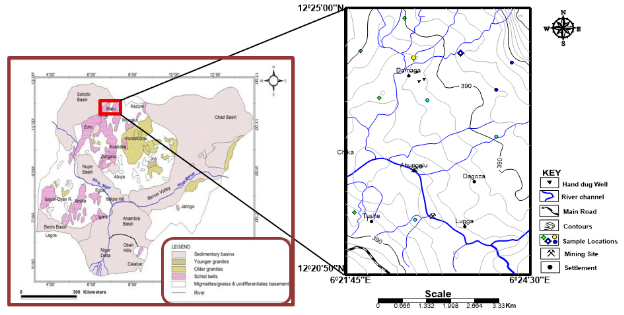
The geology and petrography of basement complex rocks in Damaga and environs were studied to identify the underlying rock types and determine their spatial coverage and mineralogical characteristics. Geological field mapping was conducted, fresh representative rock samples were collected during the field exercise, and petrographic analysis was performed on selected samples using a polarizing microscope. The major mapped rock units are granodiorite, phyllite, and amphibolite schist. Granodiorite accounts for about 38% of the total lithology and is divided into two textural groups: medium- to coarse-grained and porphyritic. It generally occurs as low-lying exposures and boulders. Phyllite is characterized by the alignment of light and dark minerals and constitutes about 34% of the total lithology, occurring mainly as low-lying outcrops exposed along river channels. Amphibolite schist covers about 20% of the total lithology and occurs largely as flat-lying outcrops. Petrographic investigations revealed that the mapped rocks are composed chiefly of felsic minerals, such as quartz, muscovite and feldspars (plagioclase and orthoclase), mafic minerals (biotite and amphibole), and minor opaque minerals. The minor lithologies, which account for 8%, consist of xenolith, aplite, and quartz veins. Structural readings revealed a dominant NE--SW trend that is consistent with Pan-African deformation.
References
[1] O. G. Olisa, O. A. Okunlola & A. A. Omitogun, ``Rare metals (Ta--Nb--Sn) mineralization potential of pegmatites of Igangan area, southwestern Nigeria'', Journal of Geoscience and Environmental Protection 6 (2018) 67. https://doi.org/10.4236/gep.2018.64005.
[2] N. A. Yusuf, M. Abdullahi & I. S. Hassan, ``Geology and petrography of basement rocks around Paki, northwestern Nigeria'', International Journal of Advances in Scientific Research and Engineering 4 (2018) 257. https://doi.org/10.31695/IJASRE.2018.33027.
[3] A. I. Aliyu, C. I. Unuevho, A. Yohanna, I. M. Sanusi, S. Aliyu, N. J. Jabo, A. I. Okkoh & M. Yahaya, ``Assessment of industrial potentials of marble deposits in Ugya, north-central Nigeria based on mineralogical and chemical studies'', Science Forum (Journal of Pure and Applied Sciences) 23 (2023) 951. https://atbuscienceforum.com.ng/index.php/jpas/article/view/144
[4] J. W. Barnes & R. J. Lisle, Basic Geological Mapping, 4th ed., John Wiley & Sons Ltd., Chichester, United Kingdom, 2004. https://download.e-bookshelf.de/download/0000/5687/49/L-G-0000568749-0002356835.pdf
[5] I. Bunyaminu, A. I. Haruna & Y. Isah, ``Geology, petrography, and microtectonic studies of rocks in Lallangi and environs, part of Bauchi Sheet 149 NE, Bauchi, northeast Nigeria'', Science Forum (Journal of Pure and Applied Sciences) 20 (2020) 174. https://doi.org/10.5455/sf.84299.
[6] O. O. Akinola, A. Ghani & E. James, ``Petrography and geochemical characterization of a granite batholith in Idanre, southwestern Nigeria'', Sains Malaysiana 50 (2021) 315. https://doi.org/10.17576/jsm-2021-5002-04.
[7] B. Aliyu & Z. Muhammad, ``Geology and petrography of Rawayya and its environs, part of Sheet 54SE, Bungudu Local Government Area of Zamfara State, Nigeria'', Earth Sciences 14 (2025) 57. https://doi.org/10.11648/j.earth.20251402.12.
[8] M. A. Mohammed, O. I. Chinedu & M. Lawal, ``Geology and mineralogy of Batola and its environs, southwestern Nigeria'', International Journal of Science for Global Sustainability 11 (2025). https://doi.org/10.57233/ijsgs.v11i2.841.
[9] R. Black, ``Precambrian of West Africa'', Episodes 3 (1980) 3. https://doi.org/10.18814/epiiugs/1980/v3i4/001.
[10] P. McCurry & J. B. Wright, ``Geochemistry of calc-alkaline volcanics in northwestern Nigeria, and a possible Pan-African suture zone'', Earth and Planetary Science Letters 37 (1977) 90. https://doi.org/10.1016/0012-821X(77)90149-2.
[11] N. Obaje, Geology and Mineral Resources of Nigeria, Springer, Berlin, Germany, 2009. https://doi.org/10.1007/978-3-540-92685-6.
[12] M. Rahman, Recent advances in the study of the Basement Complex of Nigeria, in Precambrian Geology of Nigeria, Geological Survey of Nigeria, Kaduna, Nigeria, 1988, pp. 11--43. https://www.scirp.org/reference/referencespapers?referenceid=1712445
[13] S. S. Dada, ``Proterozoic evolution of Nigeria'', in The Basement Complex of Nigeria and its Mineral Resources (A Tribute to Prof. M. A. O. Rahman), O. Oshi (Ed.), Akin Jinad & Co., Ibadan, Nigeria, 2006, pp. 29--44. https://www.scirp.org/reference/referencespapers?referenceid=1425168
[14] W. Musa, A. I. Haruna, A. S. Maigari, A. I. Jibrin, I. I. Kariya, T. Aga & H. R. Gayyemi, ``Geology and economic potentials of migmatite around Filin Shagari, Kafin Madaki (Sheet 129 NW & SW), Bauchi N.E, Nigeria'', IIARD International Journal of Geography & Environmental Management 10 (2024) 321. https://www.researchgate.net/publication/391156775_Geology_and_Economic_Potentials_of_Migmatite_Around_Filin_Shagari_Kafin_Madaki_SHEET_129_NW_SW_Bauchi_NE_Nigeria.
[15] O. A. OlaOlorun & O. O. Akinola, ``Migmatite-gneiss-granite basement of southwestern Nigeria: Mineralogical and geochemical evidence for a possible common ancient protolith'', Journal of Earth and Environmental Sciences Research 6 (2024) 1. https://www.researchgate.net/publication/382714796_Migmatite-Gneiss-Granite_Basement_of_Southwestern_Nigeria_Mineralogical_and_Geochemical_Evidence_for_a_Possible_Common_Ancient_Protolith
[16] D. C. Turner, ``Upper Proterozoic schist belts in the Nigerian sector of the Pan-African Province of West Africa'', Precambrian Research 21 (1983) 55. https://doi.org/10.1016/0301-9268(83)90005-0.
[17] M. T. Jimoh, A. T. Bolarinwa & T. Kolawale, ``Geochemical stream reconnaissance survey of the schist belt around Igbo-Ora, southwestern Nigeria'', Journal of Geology and Mining Research 7 (2015) 65. https://www.researchgate.net/publication/290472488_Geochemical_stream_reconnaissance_survey_of_the_schist_belt_around_Igbo-Ora_Southwestern_Nigeria.
[18] Y. A. Omanayin, M. Lawal, I. B. Bolaji & A. Muhammad, ``Field and petrographic studies of Basement Complex rocks in Saigbe and environs, north-central Nigeria'', Nigerian Journal of Basic and Applied Sciences 31 (2023) 49. https://doi.org/10.4314/njbas.v31i1.6.
[19] U. A. Dambatta, ``On the evolution of the Kazaure Schist Belt of NW Nigeria: A re-interpretation'', Global Journal of Geological Sciences 8 (2010) 207. https://pdfs.semanticscholar.org/07e6/6207c9447265d811b934deec1c5672ef2d38.pdf
[20] M. Abdullahi, M. A. Adediran & N. Y. Abdullahi, ``Geology and petrography of basement rocks around Tsauni, northwestern Nigeria'', International Journal of Advances in Scientific Research and Engineering 5 (2019) 257. https://www.researchgate.net/publication/332942781_Geology_and_Petrography_of_Basement_Rocks_around_Tsauni_Northwestern_Nigeria.
[21] M. Lawal, M. Mohamed, K. A. Alalade, H. Hamidu, A. M. Shuaibu, N. Y. Abdulmumin, Y. A. Omanayin & F. Salman-Adeniyi, ``Geology of Basement Complex rocks in Kabo area, Kano, northwestern Nigeria: Insights into the trends of mineralization in the region'', International Journal of Science for Global Sustainability 11 (2025) 38. https://doi.org/10.57233/ijsgs.v11i1.780.
[22] A. S. Sa'ad, I. M. Mustapha, U. Maibeti, M. K. Muhammad, J. H. Yashe, N. K. Caleb, U. Mohammed, J. I. Hassan, U. A. Usman, H. I. Kamale, A. U. Taliyawa, A. Yunusa, I. A. Yerima, A. Busuma & W. I. Suleiman, ``Petrography and structures of the Precambrian basement rocks of the Kazaure Schist Belt, northwestern Nigeria'', The Oil and Gas Journal of Engineering, Applied Sciences, Management and Art Research 3 (2024) 100. https://www.researchgate.net/publication/383358137_PETROGRAPHY_AND_STRUCTURES_OF_THE_PRECAMBRIAN_BASEMENT_ROCKS_OF_THE_KAZAURE_SCHIST_BELT_NORTHWESTERN_NIGERIA
[23] E. O. Rowland, ``Rapid method for preparation of thin rock sections'', Mineralogical Magazine 30 (1953) 254. https://www.cambridge.org/core/journals/mineralogical-magazine-and-journal-of-the-mineralogical-society/article/abs/rapid-method-for-the-preparation-of-thin-rocksections/A8EF983A1C0A0A9A0184B3EC38CB32D9
[24] J. M. El-Nafaty, ``Geology and petrography of the rocks around Gulani area, northeastern Nigeria'', Journal of Geology and Mining Research 7 (2015) 1. https://doi.org/10.5897/JGMR15.0222.
[25] A. T. Agbor, O. U. Shehu, S. H. Dantata, E. S. Jude & A. I. Asema, ``Petrographic and structural analysis of exposed rocks of Bishini Sheet (Block 2), north-central Nigeria'', Earth Science Research 2 (2013) 143. https://doi.org/10.5539/esr.v2n1p143.
[26] E. C. Ukaegbu, O. C. Okeke, U. C. Emmanuel, M. O. Okafor, T. C. Owerri, F. B. Akiang & G. A. Onwunaonyeshi, ``Role of rose diagram in the interpretation of geologic structures: A review'', World Journal of Innovation and Modern Technology 8 (2024) 163. https://doi.org/10.56201/wjimt.v8.vo5.2024.pg163.187.
[27] F. Chayes, ``A simple point counter for thin section analysis'', American Mineralogist 34 (1949) 1. https://pubs.geoscienceworld.org/msa/ammin/article-abstract/34/1-2/1/541208/A-simple-point-counter-for-thin-section-analysis?redirectedFrom=fulltext
[28] T. Age & A. I. Haruna, ``The field geology and petrography of the Kofayi Younger Granite Complex, central Nigeria'', International Journal of Advanced Geosciences 7 (2019) 95. https://scispace.com/pdf/the-field-geology-and-petrography-of-the-kofayi-younger-2p25gsv5sh.pdf
[29] R. N. Abbott Jr. & B. R. Bandy, ``Amphibolite and blueschist--greenschist facies metamorphism, Blue Mountain inlier, eastern Jamaica'', Geological Journal 43 (2008) 525. https://doi.org/10.1002/gj.1126.
[30] K. Safei, M. Ali-Arian & S. H. Moien Zadeh Mirhosseni, ``Mineral chemistry and geothermometry of amphibole and plagioclase in the metabasites, located at the Tanbour Metamorphic Complex in southern Iran'', Open Journal of Geology 5 (2015) 795. https://doi.org/10.4236/ojg.2015.511068.
[31] J. Mao, Y. Wang, H. Li, F. Pirajno, C. Zhang & R. Wang, ``The relationship of mantle-derived fluids to gold metallogenesis in the Jiaodong Peninsula: Evidence from D--O--C--S isotopes systematics'', Ore Geology Reviews 33 (2008) 361. https://doi.org/10.1016/j.oregeorev.2007.01.003.
[32] N. Mama, A. Adama, B. Ntieche, F. S. Nsang & N. Anchimbom, ``Quartz veins, evidence of hydrothermalism and postmagmatic process for mineral deposit gold and sphalerite ore in KAAKA area (Adamawa-Cameroon)'', ISAR Journal of Science and Technology 2 (2024) 5. https://www.researchgate.net/publication/383431025_Quartz_veins_evidence_of_hydrothermalism_and_postmagmatic_process_for_mineral_deposit_gold_and_sphalerite_ore_in_KAAKA_area_ADAMAWA-CAMEROON_Corresponding_Author
```:
Published
How to Cite
Issue
Section
Copyright (c) 2026 S. Aliyu, A. I. Aliyu, A. S. Usman, J. Muhammad (Author)

This work is licensed under a Creative Commons Attribution-NonCommercial-NoDerivatives 4.0 International License.