
Bernoulli-exponential survival model for estimating proportions in randomised controlled trials with dropouts

Authors

  • Ekele Alih
    Biostatistics Unit, Department of Mathematical Sciences, Federal University Oye-Ekiti, Ekiti State, Nigeria

Keywords:

Bernoulli distribution, Exponential distribution, Clinical trials, Survival models, Censoring

Abstract

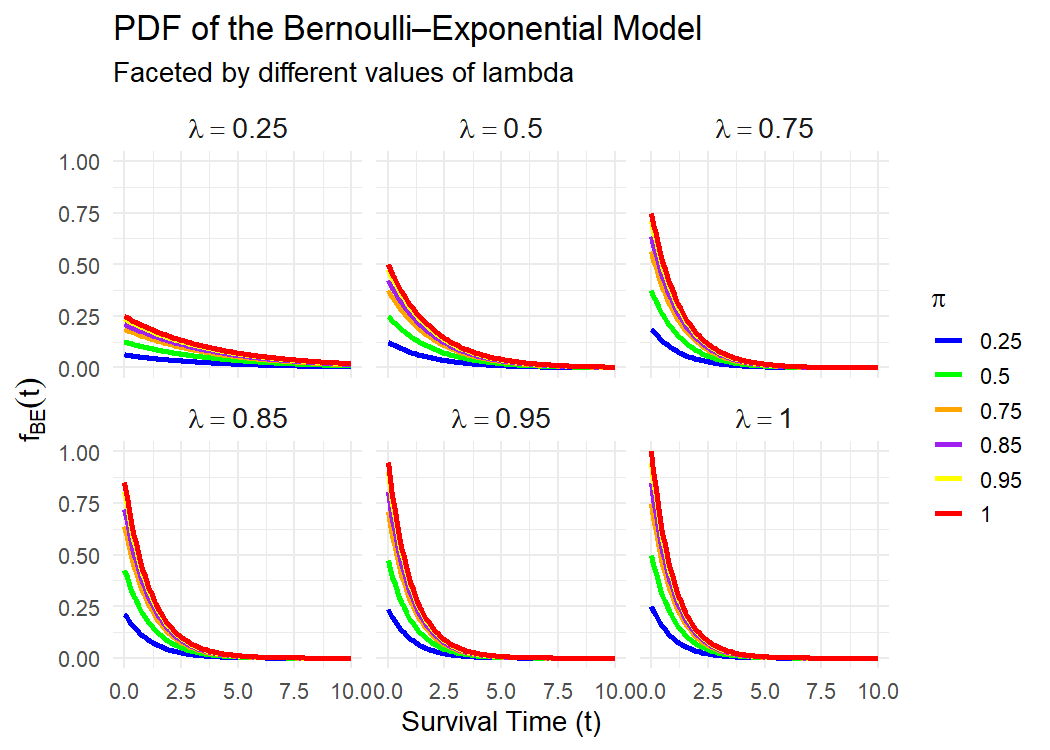
Randomised controlled trials often experience dropouts, especially in multi-stage designs where participants must meet induction-phase eligibility requirements before progressing to the main study. Loss of information arising from early non-responders or withdrawal of clinically vulnerable subjects are not always random. Classical survival analysis methods including the Kaplan-Meier estimator, exponential models, and similar techniques assume independent censoring. When this assumption is violated, survival probabilities are overstated, hazard rates are underestimated, and median survival time become biased. Such dropout mechanisms also lead to biased estimates of the proportion of participants who would experience the clinical endpoint, thereby distorting treatment effect measures based on event counts. This study proposed a Bernoulli-Exponential (BE) model that jointly represents the occurrence of an event and the time to event, rather than treating censored subjects as if they share the same risk structure as event completers. The model incorporates a Bernoulli component to describe the probability of belonging to the event-generating subgroup and an exponential component to model event times conditional on experiencing the event. This separation enables the model to account for informative dropouts, induction-phase failures, and scenarios where some participants contribute no event time. We derive the parameter estimates, survival function, and outline procedures for estimating the median survival time, its variance, and confidence interval. Simulation studies were used to assess bias and precision under varying levels of dropout. The BE estimator consistently corrected the upward bias observed in Kaplan-Meier, intention-to-treat, and completers-only estimates under heavy or informative dropout.
Dimensions

[1] J. P. Klein & M. L. Moeschberger, Survival analysis: techniques for censored and truncated data, Springer Science & Business Media, New York, 2005, pp. 63–90. https://books.google.com.ng/books?id=jS2Cy0lezJIC. DOI: https://doi.org/10.1007/0-387-21645-6_3

[2] R. A. Maller & X. Zhou, Survival analysis with long-term survivors, Wiley, Chichester, 1996, pp. 1–336. https://catalog.nlm.nih.gov/permalink/01NLM_INST/vdtut1/alma998118443406676.

[3] V. T. Farewell, “The use of mixture models for the analysis of survival data with long-term survivors”, Biometrics 38 (1982) 1041. https://doi.org/10.2307/2529885. DOI: https://doi.org/10.2307/2529885

[4] J. G. Ibrahim, M. H. Chen & D. Sinha, Bayesian survival analysis, Springer Series in Statistics, New York, 2001, pp. 1–29. http://dx.doi.org/10.1007/978-1-4757-3447-8. DOI: https://doi.org/10.1007/978-1-4757-3447-8_1

[5] H. Putter, M. Fiocco & R. B. Geskus, “Tutorial in biostatistics: competing risks and multi-state models”, Statistics in Medicine 26 (2007) 2389. https://doi.org/10.1002/sim.2712. DOI: https://doi.org/10.1002/sim.2712

[6] M. Othus, A. Bansal, H. Erba & S. Ramsey, “Bias in mean survival from fitting cure models with limited follow-up”, Value in Health 23 (2020) 1034. https://doi.org/10.1016/j.jval.2020.02.015. DOI: https://doi.org/10.1016/j.jval.2020.02.015

[7] Y. Sano, S. Tanaka & T. Sato, “Estimating cure proportion in cancer clinical trials using flexible parametric cure models”, BJC Reports 2 (2024) 1. https://doi.org/10.1038/s44276-024-00092-4. DOI: https://doi.org/10.1038/s44276-024-00092-4

[8] N. R. Latimer & M. J. Rutherford, “Mixture and non-mixture cure models for health technology assessment: What you need to know”, PharmacoEconomics 42 (2024) 1073. https://doi.org/10.1007/s40273-024-01406-7. DOI: https://doi.org/10.1007/s40273-024-01406-7

[9] H. Wang, T. Feng & B. Liang, “Improved mixture cure model using machine learning approaches”, Mathematics 13 (2025) 1. https://doi.org/10.3390/math13040557. DOI: https://doi.org/10.3390/math13040557

[10] R. Tawiah, G. J. McLachlan & S. K. Ng, “A bivariate joint frailty model with mixture framework for survival analysis of recurrent events with dependent censoring and cure fraction”, Biometrics 76 (2020) 753. https://doi.org/10.1111/biom.13202. DOI: https://doi.org/10.1111/biom.13202

[11] L. Xiang, X. Ma & K. K. Yau, “Mixture cure model with random effects for clustered interval-censored survival data”, Statistics in Medicine 30 (2011) 995. https://doi.org/10.1002/sim.4170. DOI: https://doi.org/10.1002/sim.4170

[12] L. Elena, A. Carmen & G. R. Virgilio, “Approximate Bayesian inference for mixture cure models”, arXiv preprint arXiv:1701.03769 (2018) 1. https://doi.org/10.48550/arXiv.1806.09362.

[13] P. Suvra, P. Yingwei, A. Wisdom & B. Sandip, “A support vector machine-based cure rate model for interval censored data”, Statistical Methods in Medical Research 32 (2023) 2405. https://doi.org/10.1177/09622802231210917. DOI: https://doi.org/10.1177/09622802231210917

[14] F. Felizzi, N. Paracha, J. Pöhlmann & J. Ray, “Mixture cure models in oncology: A tutorial and practical guidance”, PharmacoEconomics Open 5 (2021) 143. https://doi.org/10.1007/s41669-021-00260-z. DOI: https://doi.org/10.1007/s41669-021-00260-z

[15] S. Weichung, “Problems in dealing with missing data and informative censoring in clinical trials”, Current Controlled Trials in Cardiovascular Medicine 3 (2002) 1468. https://doi.org/10.1186/1468-6708-3-4. DOI: https://doi.org/10.1186/1468-6708-3-4

[16] V. M. Montori & G. H. Guyatt, “Intention-to-treat principle”, Canadian Medical Association Journal 165 (2001) 1339. https://pmc.ncbi.nlm.nih.gov/articles/PMC81628/.

[17] S. Kochovska, C. Huang, J. Miriam, M. R. Agar, M. T. Fallon, T. Marie, S. Kaasa, J. A. Hussain, R. K. Portenoy, I. J. Higginson & D. C. Currow, “Intention-to-treat analyses for randomized controlled trials in hospice/palliative care: The case for analyses to be of people exposed to the intervention”, Journal of Pain and Symptom Management 59 (2020) 637. https://pubmed.ncbi.nlm.nih.gov/31707068/. DOI: https://doi.org/10.1016/j.jpainsymman.2019.10.026

[18] C. Nich & K. M. Carroll, “Intention-to-treat meets missing data: implications of alternate strategies for analyzing clinical trials data”, Drug and Alcohol Dependence 68 (2002) 121. https://doi.org/10.1016/s0376-8716(02)00111-4. DOI: https://doi.org/10.1016/S0376-8716(02)00111-4

[19] J. Zee & X. S. Xie, “The Kaplan–Meier method for estimating and comparing proportions in a randomized controlled trial with dropouts”, Biostatistics & Epidemiology 2 (2018) 23. https://www.tandfonline.com/doi/full/10.1080/24709360.2017.1407866. DOI: https://doi.org/10.1080/24709360.2017.1407866

[20] J. Berkson & R. P. Gage, “Survival curve for cancer patients following treatment”, Journal of the American Statistical Association 47 (1952) 501. https://www.tandfonline.com/doi/abs/10.1080/01621459.1952.10501187. DOI: https://doi.org/10.2307/2281318

[21] R. A. Maller & Z. Xian, Survival analysis with long term survivors, Wiley, Chichester, 1996, pp. 275–276. https://doi.org/10.1002/cbm.318. DOI: https://doi.org/10.1002/cbm.318

[22] A. D. Tsodikov, J. G. Ibrahim & A. Y. Yakovlev, “Estimating cure rates from survival data: An alternative to two-component mixture models”, Journal of the American Statistical Association 98 (2003) 1063. http://www.jstor.org/stable/30045351. DOI: https://doi.org/10.1198/01622145030000001007

[23] G. McLachlan & D. Peel, Finite mixture models, Wiley, New York, 2000, pp. 40–80. https://onlinelibrary.wiley.com/doi/book/10.1002/0471721182. DOI: https://doi.org/10.1002/0471721182.ch2

[24] G. Wensheng, S. J. Ratcliffe & T. T. Ten, “A random pattern-mixture model for longitudinal data with dropouts”, Journal of the American Statistical Association 99 (2008) 929. https://doi.org/10.1198/016214504000000674. DOI: https://doi.org/10.1198/016214504000000674

[25] M. Greenwood, The natural duration of cancer, His Majesty’s Stationery Office, London, 1926, pp. 1–26. https://www.cabidigitallibrary.org/doi/full/10.5555/19272700028.

Published

2026-03-12

How to Cite

Bernoulli-exponential survival model for estimating proportions in randomised controlled trials with dropouts. (2026). Recent Advances in Natural Sciences, 4(1), 241. https://doi.org/10.61298/rans.2026.4.1.241

How to Cite

Bernoulli-exponential survival model for estimating proportions in randomised controlled trials with dropouts. (2026). Recent Advances in Natural Sciences, 4(1), 241. https://doi.org/10.61298/rans.2026.4.1.241