
Analysis of wind-speed characteristics and energy potential across North Central Nigeria

Authors

  • E. V. Tikyaa
    Department of Physics, Joseph Sarwuan Tarka University Makurdi, Benue State, Nigeria
  • E. N. Chukwuemezie
    Department of Physics, Joseph Sarwuan Tarka University Makurdi, Benue State, Nigeria
  • M. O. Audu
    Department of Physics, Joseph Sarwuan Tarka University Makurdi, Benue State, Nigeria
  • T. Igbawua
    Department of Physics, Joseph Sarwuan Tarka University Makurdi, Benue State, Nigeria

Keywords:

Wind speed, Wind energy, Weibull distribution, Lognormal distribution, Gamma distribution

Abstract

Unreliable conventional electricity supply constrains the processing and storage of agricultural produce in North Central Nigeria, contributing to food losses and insecurity. This study evaluates the region's wind-energy potential using 20 years (2001--2020) of daily wind-speed data from the Modern-Era Retrospective Analysis for Research and Applications, Version 2 (MERRA-2), produced by the National Aeronautics and Space Administration. Weibull, lognormal, and Gamma probability distribution functions were fitted to data from Abuja, Jos, Lafia, Lokoja, Makurdi, and Minna. Observed wind speeds ranged from 2.5 to 6.1 m/s, and mean wind-power densities ranged from 16.8 to 45.8 W/m2, indicating potential mainly for off-grid electricity generation and other small-scale applications. Based on higher coefficients of determination and lower root mean square errors, the Weibull distribution generally provided the best fit. Average monthly wind-energy densities increased from 12.235 kWh/m2 in Abuja to 33.010 kWh/m2 in Jos, with intermediate values of 17.759, 20.254, 24.711, and 27.664 kWh/m2 for Minna, Lokoja, Lafia, and Makurdi, respectively. These results indicate that wind energy could complement conventional supply in domestic, agricultural, and industrial facilities across the region.
Dimensions

[1] Worldometer, ``Nigeria Population (Live)”, (2026). https://www.worldometers.info/world-population/nigeria-population.

[2] M. C. Ndukwu, D. I. Onwude, L. Bennamoun, F. I. Abam, M. Simo-Tagne, I. T. Horsfall & T. A. Briggs, ``Nigeria's energy deficit: The challenges and eco-friendly approach in reducing the energy gap'', International Journal of Sustainable Engineering 14 (2021) 442. https://doi.org/10.1080/19397038.2020.1842546.

[3] World Bank, ``Nigeria to improve electricity access and services to citizens'', 5 February 2021. Available online: https://www.worldbank.org/en/news/press-release/2021/02/05/nigeria-to-improve-electricity-access-and-services-to-citizens.

[4] M. A. Alsaad, ``Wind energy potential in selected areas in Jordan'', Energy Conversion and Management 65 (2013) 704. https://doi.org/10.1016/j.enconman.2011.12.037.

[5] J. G. Leishman, Principles of Helicopter Aerodynamics, Cambridge University Press, New York, USA, 2006, pp. 17--25.

[6] S. O. Amadi & S. O. Udo, ``Analysis of trends and variations of monthly mean wind speed data in Nigeria'', Journal of Applied Physics (IOSR-JAP) 7 (2015) 31. https://doi.org/10.9790/4862-07413141.

[7] A. Allouhi, O. Zamzoum, M. R. Islam, R. Saidur, T. Kousksou, A. Jamil & A. Derouich, ``Evaluation of wind energy potential in Morocco's coastal regions'', Renewable and Sustainable Energy Reviews 72 (2017) 311. https://doi.org/10.1016/j.rser.2017.01.047.

[8] Z. H. Hulio, W. Jiang & S. Rehman, ``Technical and economic assessment of wind power potential of Nooriabad, Pakistan'', Energy, Sustainability and Society 7 (2017) 35. https://doi.org/10.1186/s13705-017-0137-9.

[9] O. M. Kam, S. Noel, H. Ramenah, P. Kasser & C. Tanougast, ``Comparative Weibull distribution methods for reliable global solar irradiance assessment in France areas'', Renewable Energy 165 (2021) 194. https://doi.org/10.1016/j.renene.2020.10.151.

[10] D. A. Fadare, ``Statistical analysis of wind energy potential in Ibadan, Nigeria, based on Weibull distribution function'', Pacific Journal of Science and Technology 9 (2008) 110. Available online: https://repository.ui.edu.ng/bitstreams/5a9d0189-507b-45f7-a0ae-4b43c7b8d656/download.

[11] F. C. Odo & G. U. Akubue, ``Comparative assessment of three models for estimating Weibull parameters for wind energy applications in a Nigerian location'', International Journal of Energy Science 2 (2012) 22. Available online: www.ijesci.org. https://www.airitilibrary.com/Article/Detail?DocID=P20150611015-201508210018-201508210018-22-25.

[12] E. C. Odo, S. U. Offiah & P. E. Ugwoke, ``Weibull distribution-based model for prediction of wind potential in Enugu, Nigeria'', Advances in Applied Sciences Research 3 (2012) 1202. Available online: https://www.pelagiaresearchlibrary.com. https://www.academia.edu/67789646/Weibull_distribution_based_model_for_prediction_of_wind_potential_in_Enugu_Nigeria.

[13] F. Fazelpour, N. Soltani & M. A. Rosen, ``Wind resource assessment and wind power potential for the city of Ardabil, Iran'', International Journal of Energy and Environmental Engineering 6 (2015) 431. https://doi.org/10.1007/s40095-014-0139-8.

[14] N. A. Udo, A. I. Oluleye & K. A. Ishola, ``Investigation of wind power potential over some selected coastal cities in Nigeria'', Innovative Energy & Research 6 (2017) 156. https://www.researchgate.net/publication/319153731_Investigation_of_Wind_Power_Potential_over_Some_Selected_Coastal_Cities_in_Nigeria.

[15] M. O. Audu, A. S. Terwase & B. C. Isikwue, ``Investigation of wind speed characteristics and its energy potential in Makurdi, North Central Nigeria'', SN Applied Sciences 1 (2019) 178. https://doi.org/10.1007/s42452-019-0189-x.

[16] E. Dokur & M. Kurban, ``Wind speed potential analysis based on Weibull distribution'', Balkan Journal of Electrical and Computer Engineering 3 (2015) 231. https://dergipark.org.tr/tr/download/article-file/458542.

[17] U. M. Nubwa, D. T. Ogbaka & J. K. Julius, ``Analysis of wind speed based on Weibull model and solar radiation potential for electricity generation in Mubi, Nigeria'', International Journal of Research and Scientific Innovation 7 (2020) 10. Available online: https://www.rsisinternational.org.

[18] U. C. Ben, A. E. Akpan, C. C. Mbonu & C. H. Ufuafuonye, ``Integrated technical analysis of wind speed data for wind energy potential assessment in parts of southern and central Nigeria'', Cleaner Engineering and Technology 2 (2021) 100049. https://doi.org/10.1016/j.clet.2021.100049.

[19] H. E. Akyuz & H. Gamgam, ``Statistical analysis of wind speed data with Weibull, lognormal and Gamma distributions'', Cumhuriyet Science Journal 38 (2017) 68. https://doi.org/10.17776/csj.358773.

[20] A. J. Saavedra Montes, P. A. Amaya Mart'inez & E. I. Arango Zuluaga, ``A statistical analysis of wind speed distribution models in the Aburr'a Valley, Colombia (Weibull, lognormal, Gamma and Rayleigh distributions)'', CT&F -- Ciencia, Tecnolog'ia y Futuro 5 (2014) 121. https://doi.org/10.29047/01225383.36.

[21] S. O. Olayinka, ``Assessment of wind energy resources for electricity generation using WECS in North-Central region, Nigeria'', Renewable and Sustainable Energy Reviews 15 (2011) 1968. https://doi.org/10.1016/j.rser.2011.01.001.

[22] G. S. Alabi & P. K. H. Olulupe, ``Review of wind energy potentials and the possibility of wind energy grid integration in Nigeria'', International Journal of Latest Research in Engineering and Technology 4 (2018) 59. Available online: http://www.ijlret.com/Papers/Vol-04-issue-05/10.B2018060.pdf.

[23] C. M. Grinstead & J. L. Snell, Conditional probability-discrete conditional probability, in Introduction to Probability (2nd ed.), American Mathematical Society (2003). p. 133.

[24] E.A. Nketiah, L. Chenlong, J. Yingchuan, B. Dwumah, ``Parameter estimation of the Weibull Distribution, Comparison of the Least-Squares Method and the Maximum Likelihood estimation'', International Journal of Advanced Engineering Research and Science (IJAERS) 8 (2021) 210. https://dx.doi.org/10.22161/ijaers.89.21.

[25] S. M. Lawan, W. A. Abidin, T. Masri, W. Y. Chai & A. Baharun, ``Wind power generation via ground wind station and topographical feed-forward neural network (T-FFNN) model for small-scale applications'', Journal of Cleaner Production 143 (2017) 1246. https://doi.org/10.1016/j.jclepro.2016.11.157.

[26] H. Jiang, J. Wang, Y. Wong & H. Lu, ``Comprehensive assessment of wind resources and the low-carbon economy: An empirical study in the Alxa and Xilin Gol leagues of Inner Mongolia, China'', Renewable and Sustainable Energy Reviews 50 (2015) 1304. https://doi.org/10.1016/j.rser.2015.05.082.

[27] E. A. Nketiah, L. Chenlong, J. Yingchuan & B. Dwumah, ``Parameter estimation of the Weibull distribution: Comparison of the least-squares method and the maximum likelihood estimation'', International Journal of Advanced Engineering Research and Science 8 (2021) 210. https://doi.org/10.22161/ijaers.89.21.

[28] N. Aras, U. Erisoglu & H. D. Y{i}ld{i}zay, ``Optimum method for determining Weibull distribution parameters used in wind energy estimation'', Pakistan Journal of Statistics and Operation Research 16 (2020) 635. https://doi.org/10.18187/pjsor.v16i4.3456.

[29] S. Kang, A. Khanjari, S. You & J.-H. Lee, ``Comparison of different statistical methods used to estimate Weibull parameters for wind speed contribution in nearby and offshore sites, Republic of Korea'', Energy Reports 7 (2021) 7358. https://doi.org/10.1016/j.egyr.2021.10.078.

[30] J. Moral de la Rubia, ``Lognormal distribution for social researchers: A probability classic'', International Journal of Psychology and Counselling 16 (2024) 10. https://journal-backups.lon1.digitaloceanspaces.com/uploads/main/article/29e9de572216.pdf.

[31] U. Eric, M.O. Oti, C.E. Francis, ``A Study of Properties and Applications of Gamma Distribution'', African Journal of Mathematics and Statistics Studies 4 (2021) 52. https://doi.org/10.52589/AJMSSMR0DQ1DG.

[32] P. N. Lecanu, J. Bréard, D. Mouazé. ``Theoretical calculation of wind (Or water) turbine considering kinetic and potential energy to exceed the Betz limit'', HAL Open Science (2023). https://hal.science/hal-01982516v12.

[33] S. H. Shami, J. Ahmad, R. Zafar, M. Haris & S. Bashir, ``Evaluating wind energy potential in Pakistan's three provinces, with proposal for integration into national power grid'', Renewable and Sustainable Energy Reviews 53 (2016) 408. https://doi.org/10.1016/j.rser.2015.08.052.

[34] Latitudelongitude.org, ``Online latitude and longitude finder'' (2024). Available online: https://latitudelongitude.org/.

[35] Altitude-maps.com, ``Get your altitude, longitude and latitude with Google Maps'' (2024). Available online: https://www.altitude-maps.com/.

[36] R. Gelaro, W. McCarty, M. J. Suarez, R. Todling, A. Molod, L. Takacs, C. Randles, A. Darmenov, M. G. Bosilovich, R. Reichle, K. Wargan, L. Coy, R. Cullather, C. Draper, S. Akella, V. Buchard, A. Conaty, A. da Silva, W. Gu, G. K. Kim, R. Koster, R. Lucchesi, D. Merkova, J. E. Nielsen, G. Partyka, S. Pawson, W. Putman, M. Rienecker, S. D. Schubert, M. Sienkiewicz & B. Zhao, ``The modern-era retrospective analysis for research and applications, version 2 (MERRA-2)'', J. Clim. 30 (2017) 5419. https://doi.org/10.1175/JCLI-D-16-0758.1.

[37] S. Tiwari & N. Gupta, ``Weibull parameter estimate for wind energy at different elevations using graphical method'', International Journal of Scientific & Technology Research 8 (2019) 2921. Available online: https://www.researchgate.net/publication/373658439_Weibull_parameter_estimate_for_Wind_Energy_at_Different_elevations_using_Graphical_Method.

[38] X. Zeng, Chaos Theory and Its Application in the Atmosphere, Paper 504, Department of Atmospheric Science, Colorado State University, Fort Collins, USA, 1992, p. 5. Available online: https://mountainscholar.org/items/5c08ac0f-160b-468f-a3f7-588f9ef93632.

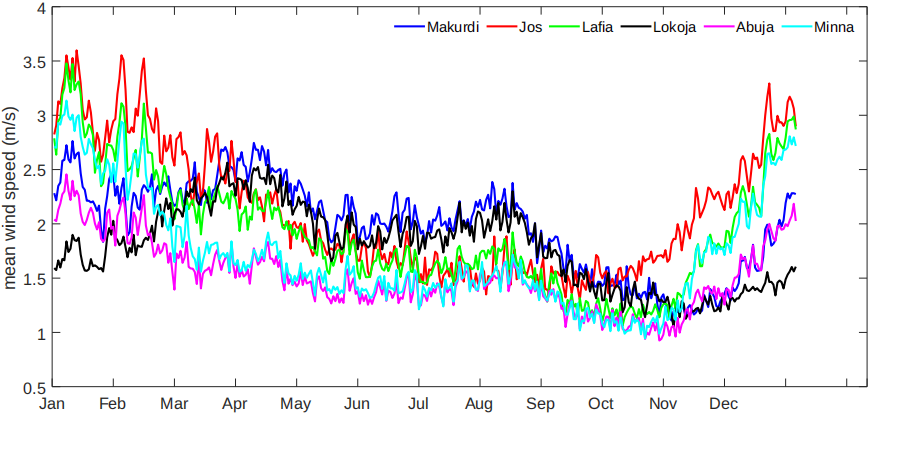
FIG14

Published

2026-08-07

How to Cite

Analysis of wind-speed characteristics and energy potential across North Central Nigeria. (2026). Recent Advances in Natural Sciences, 4(2), 351. https://doi.org/10.61298/rans.2026.4.2.351

How to Cite

Analysis of wind-speed characteristics and energy potential across North Central Nigeria. (2026). Recent Advances in Natural Sciences, 4(2), 351. https://doi.org/10.61298/rans.2026.4.2.351