Soil quality assessment of crude oil-exposed environments in Tebidaba, Bayelsa State, Nigeria

Authors

  • Namson Amadu Tsaku
    Department of Agronomy, Nasarawa State University, Shabu-Lafia Campus, Nigeria
  • Elijah Sesugh Akaaza
    Department of Soil Science, Joseph Sarwuan Tarka University, Makurdi, Benue State, Nigeria
  • Funmilayo Alfa Yusufu
    Department of Geography, College of Education Akwanga, Nasarawa State, Nigeria
  • Eche Onah Otakpa
    Department of Zoology, Faculty of Natural Sciences, University of Jos, Jos, Plateau State, Nigeria
  • Akwashiki Ombugadu
    Department of Zoology, Faculty of Life Sciences, Federal University of Lafia, Lafia, Nasarawa State, Nigeria

Keywords:

Soil quality, Crude oil exposure, Seasonality, Physicochemical properties

Abstract

Oil exploration and production activities can pose significant risks to soil quality through hydrocarbon contamination and alteration of physicochemical properties. This study assessed the impact of oil operations on soil characteristics around the Tebidaba oil flow station, Bayelsa State, Nigeria, during the 2022 wet and dry seasons. Soil samples were collected from surface (0--15 cm) and subsurface (15--30 cm) layers and analyzed alongside control samples from non-impacted areas. The soils were predominantly clay and clay loam. Mean permeability ranged from 3.49 to 3.58 m/day in surface soils and from 3.88 to 3.97 m/day in subsurface soils across seasons, while porosity ranged from 34.68 to 36.66% in surface soils and from 38.54 to 40.77% in subsurface soils. Soil pH was strongly to moderately acidic (4.11--4.49), and soil temperature averaged 26.31--27.170C. Total petroleum hydrocarbons (TPH), total hydrocarbon content (THC), and total organic carbon (TOC) were consistently higher in surface soils than in subsurface soils, while benzene, toluene, ethylbenzene, and xylene (BTEX) remained below 0.001 mg/kg in all samples. Cation exchange capacity was low, and carbonate concentrations. Overall, hydrocarbon concentrations were generally low, but periodic environmental monitoring is recommended to prevent pollutant buildup associated with oil production activities.
Dimensions

[1] W. Seifu & E. Elias, ``Soil quality attributes and their role in sustainable agriculture: a review'', International Journal of Plant & Soil Science 26 (2019) 1. https://doi.org/10.9734/IJPSS/2018/41589.

[2] V. A. Laudicina, P. Ruisi & L. Badalucco, ``Soil quality and crop nutrition'', Agriculture 13 (2023) 1412. https://doi.org/10.3390/agriculture13071412.

[3] Y. Xing, X. Wang & A. Mustafa, ``Exploring the link between soil health and crop productivity'', Ecotoxicology and Environmental Safety 289 (2025) 117703. https://doi.org/10.1016/j.ecoenv.2025.117703.

[4] N. Bilyera, B. L. Turner, X. Zhang, H. Zang, M. Dorodnikov & Y. Kuzyakov, ``Soil health under global change and human impact'', Land Degradation & Development 36 (2025) 683. https://doi.org/10.1002/ldr.5487.

[5] A. N. Yadav, D. Kour, T. Kaur, R. Devi, A. Yadav, M. Dikilitas, A. M. Abdel-Azeem, A. S. Ahluwalia & A. K. Saxena, ``Biodiversity, and biotechnological contribution of beneficial soil microbiomes for nutrient cycling, plant growth improvement and nutrient uptake'', Biocatalysis and Agricultural Biotechnology 33 (2021) 102009. https://doi.org/10.1016/j.bcab.2021.102009.

[6] S. Nortcliff, ``Standardisation of soil quality attributes'', Agriculture, Ecosystems & Environment 88 (2002) 161. https://doi.org/10.1016/S0167-8809(01)00253-5.

[7] M. A. Adeniran, M. A. Oladunjoye & K. O. Doro, ``Soil and groundwater contamination by crude oil spillage: A review and implications for remediation projects in Nigeria'', Frontiers in Environmental Science 11 (2023) 1137496. https://doi.org/10.3389/fenvs.2023.1137496.

[8] N. Zabbey, K. Sam & A. T. Onyebuchi, ``Remediation of contaminated lands in the Niger Delta, Nigeria: Prospects and challenges'', Science of the Total Environment 586 (2017) 952. https://doi.org/10.1016/j.scitotenv.2017.02.075.

[9] B. O. Akagbue, T. O. Popoola, M. B. Aminu, J. A. Nenger & S. Babatunde, ``Negative health and environmental effects of oil exploitation in Southern Ijaw, Bayelsa State, Nigeria'', European Journal of Environment and Earth Sciences 5 (2024) 34. https://doi.org/10.24018/ejgeo.2024.5.3.464.

[10] G. W. Gee & D. Or, {``Particle-size analysis''}, in Methods of Soil Analysis, Part 4: Physical Methods, J. H. Dane & G. C. Topp (Eds.), Soil Science Society of America, Madison, WI, USA, 2002, pp. 255--293. https://doi.org/10.2136/sssabookser5.4.c12

[11] M. R. Carter, Soil Sampling and Methods of Analysis, Lewis Publishers, Boca Raton, FL, USA, 1993.

[12] Association of Official Analytical Chemists, Official Methods of Analysis of AOAC International, 16th ed., 5th revision, AOAC International, Gaithersburg, MD, USA, 1999.

[13] J. Murphy & J. P. Riley, ``A modified single solution method for the determination of phosphate in natural waters'', Analytica Chimica Acta 27 (1962) 31. https://doi.org/10.1016/S0003-2670(00)88444-5.

[14] A. L. Page, R. H. Miller & D. R. Keeney, Methods of Soil Analysis, Part 2: Chemical and Microbiological Properties, 2nd ed., American Society of Agronomy, Madison, WI, USA, 1982. https://acsess.onlinelibrary.wiley.com/doi/pdf/10.2134/agronmonogr9.2.2ed.frontmatter

[15] Association of Official Analytical Chemists, Official Methods of Analysis of AOAC International, 18th ed., AOAC International, Gaithersburg, MD, USA, 2005. https://www.researchgate.net/publication/292783651_AOAC_2005.

[16] ASTM International, Standard Test Methods for Oil and Grease and Petroleum Hydrocarbons in Water, ASTM International, West Conshohocken, PA, USA, 1988. https://www.academia.edu/34069603/Standard_Test_Method_for_Oil_and_Grease_and_Petroleum_Hydrocarbons_in_Water_1.

[17] ASTM International, Standard Test Methods for Determination of Total Hydrocarbons in Soil, Sediment, and Water Samples (D3921, D4657), ASTM International, West Conshohocken, PA, USA, 2004.

[18] United States Environmental Protection Agency, Test Methods for Evaluating Solid Waste, Physical/Chemical Methods (SW-846), Method 8270B, United States Environmental Protection Agency, Washington, DC, USA, 1996. https://archive.epa.gov/epawaste/hazard/testmethods/web/pdf/1050.pdf.

[19] United States Environmental Protection Agency, Test Methods for Determining Petroleum Hydrocarbons, Method 1625, United States Environmental Protection Agency, Washington, DC, USA, 1998. http://www.epa.gov/OST/methods/.

[20] I. N. Anyanwu, S. Beggel, F. D. Sikoki, E. O. Okuku & J. P. Unyimadu, ``Pollution of the Niger Delta with total petroleum hydrocarbons, heavy metals and nutrients in relation to seasonal dynamics'', Scientific Reports 13 (2023) 14079. https://doi.org/10.1038/s41598-023-40995-9.

[21] I. J. Alinnor & I. N. Nwachukwu, ``Determination of total petroleum hydrocarbon in soil and groundwater samples from five communities in Rivers State of Nigeria'', Journal of Environmental Chemistry and Ecotoxicology 5 (2013) 292. https://academicjournals.org/article/article1387438960_Alinnor%20and%20Nwachukwu.pdf.

[22] N. S. Ahmad Sabri, Z. Zakaria, S. E. Mohamad, A. B. Jaafar & H. Hara, ``Importance of soil temperature for the growth of temperate crops under a tropical climate and functional role of soil microbial diversity'', Microbes and Environments 33 (2018) 144. https://doi.org/10.1264/jsme2.ME17181.

[23] O. Lindén & J. Pålsson, ``Oil contamination in Ogoniland, Niger Delta'', Ambio 42 (2013) 685. https://doi.org/10.1007/s13280-013-0412-8.

[24] E. W. Odali, C. M. A. Iwegbue, F. E. Egobueze, G. E. Nwajei & B. S. Martincigh, ``Distribution, sources, and risk of polycyclic aromatic hydrocarbons in soils from rural communities around gas-flaring points in the Niger Delta of Nigeria'', Environmental Science: Processes & Impacts 26 (2024) 721. https://doi.org/10.1039/d3em00067b.

[25] N. C. Brady & R. R. Weil, The Nature and Properties of Soils, 14th ed., Pearson, Upper Saddle River, NJ, USA, 2008. https://www.amazon.com/Nature-Properties-Soils-14th/dp/013227938X#detailBullets_feature_div

[26] M. Ayman, ``Enhancing potassium availability and dynamics in some Egyptian soils through biochar application'', Scientific Reports 16 (2026) 6338. https://doi.org/10.1038/s41598-026-36281-z.

[27] P. C. Nwilo & T. O. Badejo, ``Impacts and management of oil spill pollution along the Nigerian coastal areas'', in Administering Marine Spaces: International Issues, International Federation of Surveyors, Copenhagen, Denmark, 2006, p. 119. Available online: https://www.fig.net/resources/publications/figpub/pub36/chapters/chapter_8.pdf.

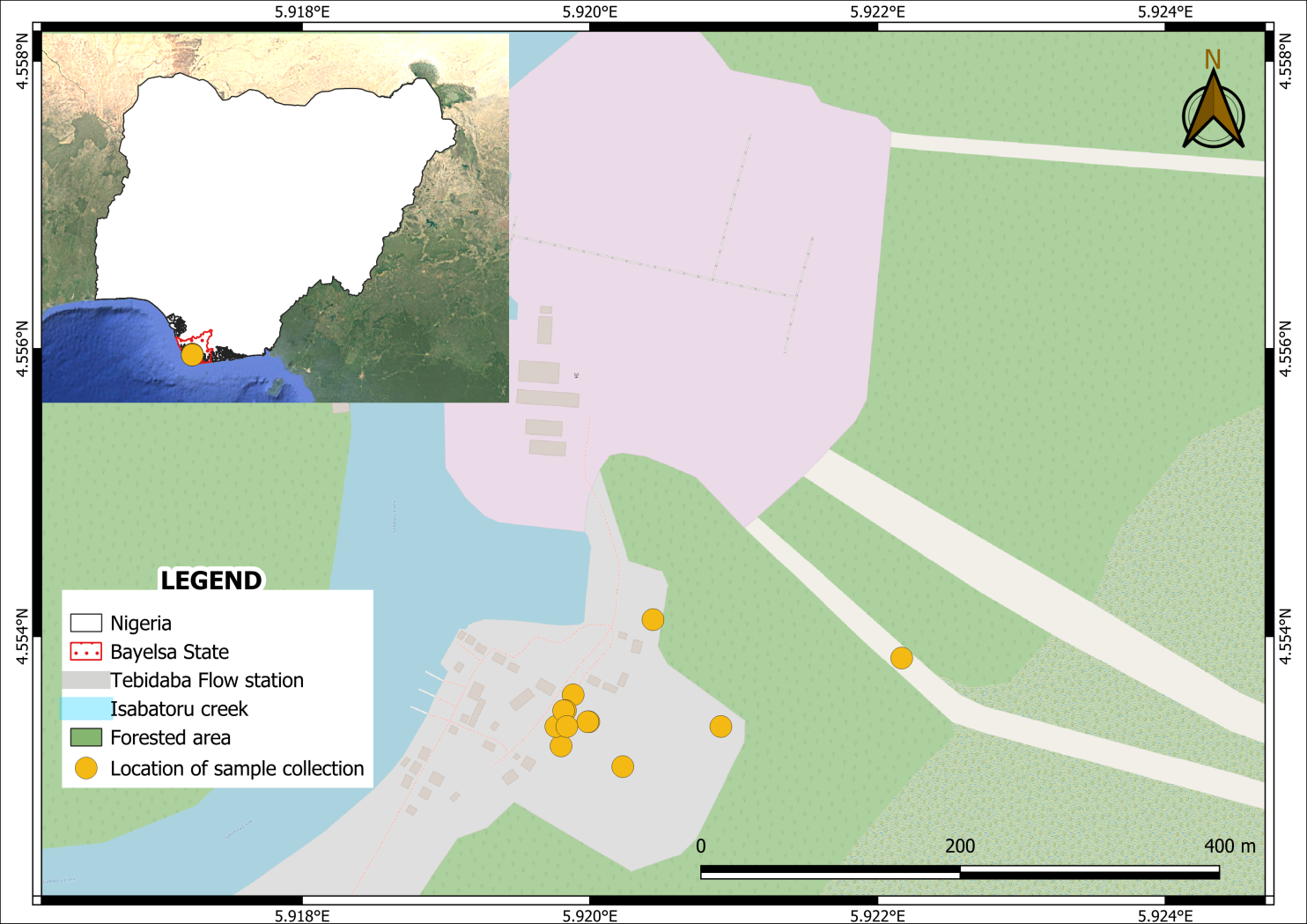
fig 1

Published

2026-07-16

How to Cite

Soil quality assessment of crude oil-exposed environments in Tebidaba, Bayelsa State, Nigeria. (2026). Terratmosphera, 1(2), 372. https://doi.org/10.61298/terratmosphera.2026.1.2.372

Issue

Section

Environmental/Pollution Studies

How to Cite

Soil quality assessment of crude oil-exposed environments in Tebidaba, Bayelsa State, Nigeria. (2026). Terratmosphera, 1(2), 372. https://doi.org/10.61298/terratmosphera.2026.1.2.372

Similar Articles

You may also start an advanced similarity search for this article.