Assessment of some physicochemical parameters and heavy metals in River Benue at Wurukum abattoir, Makurdi Metropolis, Benue State, Nigeria

Authors

  • Mathew Olaleke Aremu
    Department of Chemistry, Federal University of Lafia, P.M.B. 146, Lafia, Nasarawa State, Nigeria
  • Benjamin Zobada Musa
    Department of Chemistry, Federal University of Lafia, P.M.B. 146, Lafia, Nasarawa State, Nigeria
    Department of Chemistry, Federal University of Agriculture, Zuru, PMB 28, Kebbi State, Nigeria
  • Catherine Mnena Aba
    Department of Chemistry, Federal University of Lafia, P.M.B. 146, Lafia, Nasarawa State, Nigeria
  • Bilyamin Ishaq
    Department of Chemistry, Federal University of Lafia, P.M.B. 146, Lafia, Nasarawa State, Nigeria
  • Jude Chinedu Onwuka
    Department of Chemistry, Federal University of Lafia, P.M.B. 146, Lafia, Nasarawa State, Nigeria
  • Augustine Uche Abel
    Department of Chemistry, Federal University of Lafia, P.M.B. 146, Lafia, Nasarawa State, Nigeria
  • Francis Busuyi Iyiola
    Department of Science Education, University of Nigeria, Nsukka, Enugu State, Nigeria

Keywords:

River Benue, Abattoir effluent, Physicochemical parameters, Heavy metals

Abstract

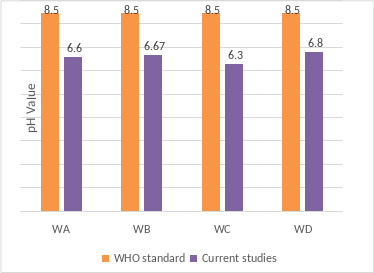
This study assessed the impact of abattoir effluents on the water quality of River Benue around the Wurukum Abattoir, Makurdi, Benue State, Nigeria, using selected physicochemical parameters and heavy metal concentrations as pollution indicators. Water samples were collected from four sampling stations and analysed using standard methods recommended by the American Public Health Association (APHA) and the Association of Official Analytical Chemists (AOAC). Temperature, pH, electrical conductivity (EC), dissolved oxygen (DO), biochemical oxygen demand (BOD), total solids (TS), total dissolved solids (TDS), total suspended solids (TSS), total hardness (TH), and total acidity (TA) were measured, while heavy metals were analysed by atomic absorption spectrophotometry (AAS). Temperature (28.97--29.30 0C), pH (6.3--6.8), and EC (30--90 μS/cm) were within acceptable ranges for freshwater systems. Total hardness ranged from 158 to 180~mg/L, indicating hard-water conditions. DO concentrations were low (0.94--2.16~mg/L), indicating limited oxygen availability. BOD ranged from 2.2 to 79~mg/L, with the highest value at the abattoir discharge point, suggesting substantial organic loading from untreated effluent. Chromium (0.327--0.532~mg/L), lead (1.885--2.716~mg/L), and manganese (0.075--1.772~mg/L) exceeded permissible drinking-water limits, while cadmium was not detected. The findings indicate that abattoir effluents and other anthropogenic activities contribute to water-quality deterioration in River Benue.
Dimensions

[1] T. Bakare-Abidola, J. Olaoye & O. S. Yekinni, ``Environmental assessment of heavy metal contamination and physicochemical properties in abattoir wastewater'', GSC Advanced Research and Reviews 22 (2025) 92. https://doi.org/10.30574/gscarr.2025.22.3.0067.

[2] I. A. Ololade, A. O. Apata, N. A. Oladoja, O. J. Oloyede, O. O. Ololade, O. P. Asanga & F. F. Oloye, ``Occurrence, seasonal distribution and probabilistic source-specific health risk assessment of dissolved trace metals in southwestern rivers, Nigeria'', Science of the Total Environment 963 (2025) 178342. https://doi.org/10.1016/j.scitotenv.2024.178342.

[3] World Health Organization, ``Drinking-water'', 2023. Available online: https://www.who.int/en/news-room/fact-sheets/detail/drinking-water.

[4] C. N. Amaechi-Onyerimma, O. A. F. Wokoma & A. C. Onugha, ``Assessment of heavy metal composition of abattoir effluents on the quality of groundwater in Port Harcourt Metropolis, Rivers State'', IAU-Journal of Applied and Environmental Biology 1 (2023) 88. https://www.researchgate.net/publication/371671413_ASSESSMENT_OF_HEAVY_METAL_COMPOSITION_OF_ABATTOIR_EFFLUENTS_ON_THE_QUALITY_OF_GROUNDWATER_IN_PORT_HARCOURT_METROPOLIS_RIVERS_STATE.

[5] T. O. Yahaya, E. O. Oladele, I. A. Fatodu, A. Abdulazeez & Y. I. Yeldu, ``The concentration and health risk assessment of heavy metals and microorganisms in the groundwater of Lagos, Southwest Nigeria'', Journal of Advances in Environmental Health Research 8 (2020) 225. https://doi.org/10.22102/jaehr.2020.245629.1183.

[6] United States Environmental Protection Agency, ``Types of nonpoint source pollution'', 2026. Available online: https://www.epa.gov/nps/types-nonpoint-source-pollution.

[7] S. Sati, P. K. Sharma, P. Naithani, P. K. Jha, V. Panwar, N. R. Behera, R. Karmakar, Prashant & A. Mittal, ``Bioremediation of heavy metals in contaminated water: conventional vs. advanced methods'', Frontiers in Water 8 (2026) 1749800. https://doi.org/10.3389/frwa.2026.1749800.

[8] P. Zhang, M. Yang, J. Lan, Y. Huang, J. Zhang, S. Huang, Y. Yang & J. Ru, ``Water quality degradation due to heavy metal contamination: health impacts and eco-friendly approaches for heavy metal remediation'', Toxics 11 (2023) 828. https://doi.org/10.3390/toxics11100828.

[9] S. Nandomah & I. K. Tetteh, ``Potential ecological risk assessment of heavy metals associated with abattoir liquid waste: a narrative and systematic review'', Heliyon 9 (2023) e17359. https://doi.org/10.1016/j.heliyon.2023.e17359.

[10] C. Y. Abasi, O. G. Aliene, E. P. Salvation & O. Nimighaye, ``The impacts of abattoir waste on soil and water quality: a review'', International Journal of Research and Innovation in Applied Science 9 (2024) 72. https://doi.org/10.51584/IJRIAS.2024.911007.

[11] O. T. Fatunsin, I. G. Enenya & P. Ebomese, ``Effect of abattoir activities on the quality of water and surrounding soil of the Anwai River in Asaba, Nigeria'', African Journal of Aquatic Science 48 (2023) 404. https://doi.org/10.2989/16085914.2023.2288346.

[12] O. O. Elemile, D. O. Raphael, D. O. Omole, E. O. Oloruntoba, E. O. Ajayi & N. A. Ohwavborua, ``Assessment of the impact of abattoir effluent on the quality of groundwater in a residential area of Omu-Aran, Nigeria'', Environmental Sciences Europe 31 (2019) 16. https://doi.org/10.1186/s12302-019-0201-5.

[13] P. A. N. Oghonim, S. C. Onuorah, C. S. Onyima, P. N. Idu, B. O. Uba, C. E. Onyekpeze, A. Eseoghene, E. J. Alari, G. Osunde & F. Ottah, ``Public health risk assessment of heavy metal contamination in abattoir wastewater-irrigated soil and edible crops in Agbor, Delta State, Nigeria'', INOSR Applied Sciences 14 (2026) 9. https://doi.org/10.59298/INOSRAS/2026/14.1.917000.

[14] V. T. Omoni, P. O. Bankole, O. Omoche, C. Obida, C. Igben, O. E. Stephen, E. I. Ogwo & D. N. Torjir, ``Evaluation of the effects of abattoir effluent on the physicochemical and bacteriological quality of River Benue, Nigeria'', Environmental Monitoring and Assessment 195 (2023) 146. https://doi.org/10.1007/s10661-022-10768-4.

[15] C. P. Aleru, V. N. Agi, J. Lawson-Ndu & Q. N. Eme, ``Determination of bacterial quality of water in randomly selected swimming pools in Port Harcourt and Obio-Akpo Local Government Areas, Rivers State, Nigeria'', Journal of Medical Science and Clinical Research 9 (2021) 134. https://www.researchgate.net/publication/349104923_Determination_of_Bacterial_Quality_of_Water_in_Randomly_Selected_Swimming_Pools_in_Port_Harcourt_and_Obio-Akpo_Local_Government_Areas_Rivers_State_Nigeria.

[16] World Geodetic Coordinate Database, ``Latitude and longitude of Makurdi, Nigeria'', 2026. Available online: https://latlong.info/nigeria/benue/makurdi?utm_source=chatgpt.com.

[17] Association of Official Analytical Chemists, Official Methods of Analysis of AOAC International, 22nd ed., AOAC International, Rockville, MD, USA, 2023. https://doi.org/10.1093/9780197610145.002.001.

[18] American Public Health Association, American Water Works Association & Water Environment Federation, Standard Methods for the Examination of Water and Wastewater, 24th ed., APHA Press, Washington, DC, USA, 2023. https://www.standardmethods.org/buy/.

[19] United States Environmental Protection Agency, ``Guidelines establishing test procedures for the analysis of pollutants'', 2022. Available online: https://www.epa.gov/cwa-methods?utm_source=chatgpt.com.

[20] Shimadzu Corporation, Atomic absorption spectrophotometry analytical guidebook, Shimadzu Scientific Instruments, Kyoto, Japan, 2021. https://www.shimadzu.com.au/products/elemental-analysis/atomic-absorption-spectroscopy/aa-7000/index.html.

[21] World Health Organization, Guidelines for Drinking-water Quality, 4th ed., incorporating the first and second addenda, World Health Organization, Geneva, Switzerland, 2022. Available online: https://www.who.int/publications/i/item/9789240045064.

[22] R. T. Iwar, J. T. Utsev & M. Hassan, ``Assessment of heavy metal and physicochemical pollution loadings of River Benue water at Makurdi using water quality index (WQI) and multivariate statistics'', Applied Water Science 11 (2021) 124. https://doi.org/10.1007/s13201-021-01456-8.

fig3

Published

2026-07-14

How to Cite

Assessment of some physicochemical parameters and heavy metals in River Benue at Wurukum abattoir, Makurdi Metropolis, Benue State, Nigeria. (2026). Terratmosphera, 1(1), 384. https://doi.org/10.61298/terratmosphera.2026.1.1.384

Issue

Section

Environmental/Pollution Studies

How to Cite

Assessment of some physicochemical parameters and heavy metals in River Benue at Wurukum abattoir, Makurdi Metropolis, Benue State, Nigeria. (2026). Terratmosphera, 1(1), 384. https://doi.org/10.61298/terratmosphera.2026.1.1.384

Similar Articles

You may also start an advanced similarity search for this article.