Spatial and temporal estimation of groundwater recharge in Kabago watershed using the soil and water assessment tool (SWAT) hydrological model: implications for sustainable water resource management in Northwestern Nigeria

Authors

  • A. M. Shuaibu
    Department of Geology, Faculty of Science, Federal University Lokoja, Kogi State
  • K. O. Musa
    Department of Geology, Faculty of Science, Federal University Lokoja, Kogi State
  • K. A. Murana
    Department of Geological Sciences, Faculty Science, Federal University Gusau, Zamfara State
  • Mutari Lawal
    Department of Geology and Gemology, Faculty of Science, University of Abuja, P.M.B. 117, FCT Abuja, Nigeria

Keywords:

SWAT Model, Groundwater recharge, Water budget, Hydrologic response unit, Kabago watershed

Abstract

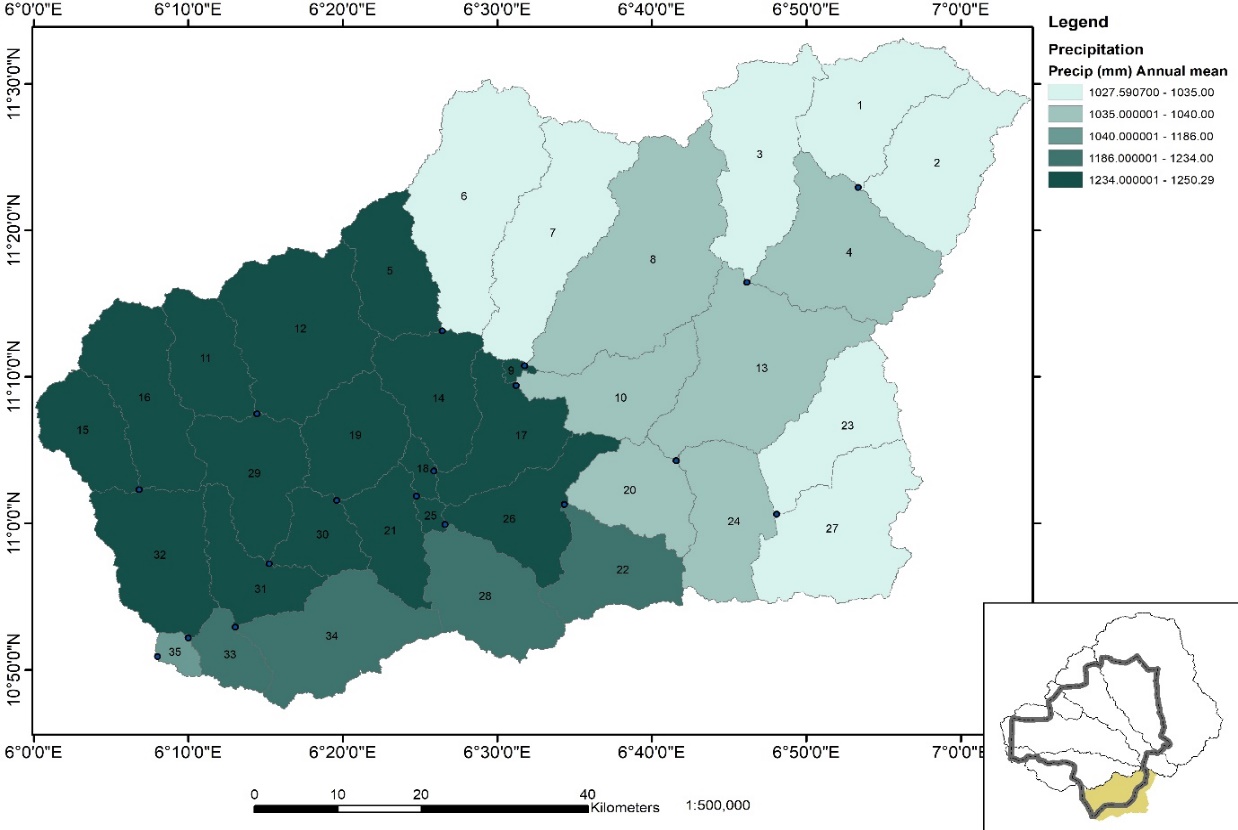
Assessing groundwater recharge is essential for managing water resources sustainably, especially in semi-arid regions. In order to assess groundwater reserves for residential and agricultural use, this study examines the spatial and temporal distribution of recharge in the Kabago watershed in Southern Zamfara State, Nigeria. The watershed, which is roughly 5.97 km² in size and is composed of migmatite, gneiss, schist, and granitic rocks, has a Sudan savannah climate with high evapotranspiration and little annual rainfall (1164 mm). Hydrological processes during a 21-year period (1990–2010) were simulated using the Soil and Water Assessment Tool (SWAT 2012) linked with ArcGIS. SUFI-2 in SWAT-CUP was used for calibration and validation utilizing streamflow data from the Maru gauging station. With NSE values of 0.85 and 0.75, R2 values of 0.85 and 0.75, PBIAS of 2.5% and –1.3%, and RSR values of 0.43 and 0.52 for calibration and validation, respectively, the model performed satisfactorily. Soil water capacity, groundwater delay, baseflow coefficient, and surface runoff factors were among the sensitive characteristics. The results indicated that model-derived potential recharge values, which represent roughly 49% of annual precipitation, ranged from 379.93 to 678.88 mm/year with an average of 545.69 mm/year. Runoff and evapotranspiration were responsible for 15.35% (178.65 mm/year) and 33.24% (386.93 mm/year) of the water loss, respectively. Recharge variability was largely influenced by rainfall distribution, soil type, slope, and land use, with agricultural land promoting infiltration. Overall, the Kabago watershed functions as a significant recharge zone, though high evapotranspiration highlights vulnerability to land use and climate change. These findings provide a sound basis for groundwater management and policy in Zamfara and comparable semi-arid regions.
Dimensions

[1] R. A. Aslam, S. Shrestha, M. N. Usman, S. N. Khan, S. Ali, M. S. Sharif, M. W. Sarwar, N. Saddique, A. Sarwar & M. U. Ali, “Integrated SWAT-MODFLOW modeling-based groundwater adaptation policy guidelines for Lahore, Pakistan under Projected Climate Change, and Human Development Scenarios”, Atmosphere 13 (2022) 2001. https://doi.org/10.3390/atmos13122001. DOI: https://doi.org/10.3390/atmos13122001

[2] A. Arshad, A. Mirchi, M. Samimi & B. Ahmad, “Combining downscaled-grace data with SWAT to improve the estimation of groundwater storage and depletion variations in the irrigated Indus Basin (IIB)”, Sci. Total Environ. 838 (2022) 156044. https://doi.org/10.1016/j.scitotenv.2022.156044. DOI: https://doi.org/10.1016/j.scitotenv.2022.156044

[3] L. Locatelli, O. Mark, P. S. Mikkelsen, K. Arnbjerg-Nielsen, A. Deletic, M. Roldin & P. J. Binning, “Hydrologic impact of urbanization with extensive stormwater infiltration”, J. Hydrol. 544 (2017) 524. https://doi.org/10.1016/j.jhydrol.2016.11.030. DOI: https://doi.org/10.1016/j.jhydrol.2016.11.030

[4] O. V. Barron, M. J. Donn & A. D. Barr, “Urbanization and shallow groundwater: predicting changes in catchment hydrological responses”, Water Resour. Manag. 27 (2013) 95. https://doi.org/10.1016/j.jhydrol.2012.04.027. DOI: https://doi.org/10.1007/s11269-012-0168-0

[5] H. Desta & B. Lemma, “SWAT based hydrological assessment and characterization of Lake Ziway sub-watersheds, Ethiopia”, J. Hydrol. Reg. Stud. 13 (2017) 122. https://doi.org/10.1016/j.ejrh.2017.08.002. DOI: https://doi.org/10.1016/j.ejrh.2017.08.002

[6] A. M. Shuaibu & K. A. Murana, “SWAT hydrological model of Zamfara watershed of Sokoto-Rima River catchment, North West Nigeria”, Niger. J. Technol. 43 (2024) 411. https://www.ajol.info/index.php/njt/article/view/288061. DOI: https://doi.org/10.4314/njt.v43i4.22

[7] B. Berehanu, T. Ayenew & T. Azagegn, “Challenges of groundwater flow model calibration using MOD-FLOW in Ethiopia: With particular emphasis to the Upper Awash River Basin”, J. Geosci. Environ. Prot. 5 (2017) 50. https://doi.org/10.4236/gep.2017.53005. DOI: https://doi.org/10.4236/gep.2017.53005

[8] H. C. Nair, D. Padmalal, A. Joseph & P. G. Vinod, “Delineation of groundwater potential zones in river basins using geospatial tools — An example from Southern Western Ghats, Kerala, India”, J. Geovis. Spat. Anal. 1 (2017) 5. https://doi.org/10.1007/s41651-017-0003-5. DOI: https://doi.org/10.1007/s41651-017-0003-5

[9] E. Mosase, L. Ahiablame, S. Park & R. Bailey, “Modelling potential groundwater recharge in the Limpopo River Basin with SWAT-MODFLOW”, Groundw. Sustain. Dev. 9 (2019) 100260. https://doi.org/10.1016/j.gsd.2019.100260. DOI: https://doi.org/10.1016/j.gsd.2019.100260

[10] M. Sophocleous & S. P. Perkins, “Methodology and application of combined watershed and groundwater models in Kansas”, J. Hydrol. 236 (2000) 185. https://doi.org/10.1016/S0022-1694(00)00293-6. DOI: https://doi.org/10.1016/S0022-1694(00)00293-6

[11] D. Chunn, M. Faramarzi, B. Smerdon & D. Alessi, “Application of an integrated SWAT–MODFLOW model to evaluate potential impacts of climate change and water withdrawals on groundwater–surface water interactions in West-Central Alberta”, Water 11 (2019) 110. https://doi.org/10.3390/w11010110. DOI: https://doi.org/10.3390/w11010110

[12] M. Zambrano-Bigiarini & R. A. Rojas, “Model-independent particle swarm optimisation software for model calibration”, Environ. Model. Softw. 43 (2013) 5. https://doi.org/10.1016/j.envsoft.2013.01.004. DOI: https://doi.org/10.1016/j.envsoft.2013.01.004

[13] L. Yuan, T. Sinshaw & K. J. Forshay, “Review of watershed-scale water quality and nonpoint source pollution models”, Geosciences 10 (2020) 25. https://doi.org/10.3390/geosciences10010025. DOI: https://doi.org/10.3390/geosciences10010025

[14] V. Hung Vu & B. J. Merkel, “Estimating groundwater recharge for Hanoi, Vietnam”, Sci. Total Environ. 651 (2019) 1047. https://doi.org/10.1016/j.scitotenv.2018.09.225. DOI: https://doi.org/10.1016/j.scitotenv.2018.09.225

[15] C. Simsek, A. C. Demirkesen, A. Baba, A. Kumanl?oglu, S. Durukan, N. Aksoy, Z. Demirk?ran, A. Hasözbek, A. Murathan & G. Tayfur, “Estimation groundwater total recharge and discharge using GIS-integrated water level fluctuation method: A case study from the Alasehir Alluvial aquifer Western Anatolia, Turkey”, Arab. J. Geosci. 13 (2020) 143. https://doi.org/10.1007/s12517-020-5062-0.

[16] H. Delottier, A. Pryet, J. M. Lemieux & A. Dupuy, “Estimating groundwater recharge uncertainty from joint application of an aquifer test and the water-table fluctuation method”, Hydrogeol. J. 26 (2018) 2495. https://doi.org/10.1007/s10040-018-1790-6.

[17] I. M. Chung, Y. J. Kim & N. W. Kim, “Estimating the temporal distribution of groundwater recharge by using the transient water table fluctuation method and watershed hydrologic model”, Appl. Eng. Agric. 37 (2021) 95. https://doi.org/10.13031/aea.13376. DOI: https://doi.org/10.13031/aea.13376

[18] E. Park, “Delineation of recharge rate from a hybrid water table fluctuation method”, Water Resour. Res. 48 (2012) 109. https://doi.org/10.1029/2011WR011696.

[19] A. Gumu?a-Kawecka, B. Jaworska-Szulc, A. Szymkiewicz, W. Gorczewska-Langner, M. Pruszkowska-Caceres, R. Angulo Jaramillo & J. Simunek, “Estimation of groundwater recharge in a shallow sandy aquifer using unsaturated zone modeling and water table fluctuation method”, J. Hydrol. 605 (2022) 127283. https://doi.org/10.1016/j.jhydrol.2021.127283.

[20] A. M. Shuaibu, K. O. Musa & I. M. Okiyi, “Groundwater recharge modelling using SWAT analysis for groundwater reserve quantification of Ka watershed catchment area part of Sokoto-Rima Basin, North West Nigeria”, Afr. Sci. Rep. 4 (2025) 255. https://doi.org/10.46481/asr.2025.4.1.255. DOI: https://doi.org/10.46481/asr.2025.4.1.255

[21] A. R. Cobb & C. F. Harvey, “Scalar simulation and parameterization of water table dynamics in tropical peatlands”, Water Resour. Res. 55 (2019) 9351. https://doi.org/10.1029/2019WR025411. DOI: https://doi.org/10.1029/2019WR025411

[22] F. Hussain, R. S. Wu & D. S. Shih, “Water table response to rainfall and groundwater simulation using physics-based numerical model: WASH123D”, J. Hydrol. Reg. Stud. 39 (2022) 100988. https://doi.org/10.1016/j.ejrh.2022.100988. DOI: https://doi.org/10.1016/j.ejrh.2022.100988

[23] M. Faramarzi, R. Srinivasan, M. Iravani, K. D. Bladon, K. C. Abbaspour, A. J. B. Zehnder & G. G. Goss, “Setting up a hydrological model of alberta: data discrimination analyses prior to calibration”, Environ. Model. Softw. 74 (2015) 48. https://doi.org/10.1016/j.envsoft.2015.09.006. DOI: https://doi.org/10.1016/j.envsoft.2015.09.006

[24] K. C. Abbaspour, “SWAT-CUP SWAT calibration and uncertainty programs”, Arch. Orthop. Trauma Surg. 130 (2010) 965. https://doi.org/10.13031/2013.23153.

[25] D. N. Moriasi, J. G. Arnold, M. W. Van Liew, R. L. Bingner, R. D. Harmel & T. L. Veith, Model evaluation guidelines for systematic quantification of accuracy in watershed simulations, ASABE, 2007, pp. 885–900. https://doi.org/10.13031/2013.23153. DOI: https://doi.org/10.13031/2013.23153

[26] T. Jafari, A. S. Kiem, S. Javadi, T. Nakamura & K. Nishida, “Fully integrated numerical simulation of surface water-groundwater interactions using SWAT-MODFLOW with an improved calibration tool”, J. Hydrol. Reg. Stud. 35 (2021) 100822. https://doi.org/10.1016/j.ejrh.2021.100822. DOI: https://doi.org/10.1016/j.ejrh.2021.100822

[27] S. Park, Enhancement of coupled surface/subsurface flow models in watersheds: analysis, model development, optimization, and user accessibility by using SWAT-MODFLOW simulation, Ph.D. dissertation, Colorado State University, Colorado, USA, 2018. https://mountainscholar.org/bitstream/handle/10217/193164/Park_colostate_0053A_15199.pdf?sequence=1.

[28] K. C. Abbaspour, E. Rouholahnejad, S. Vaghefi, R. Srinivasan, H. Yang & B. A. Klove, “A continental-scale hydrology and water quality model for Europe: calibration and uncertainty of a high-resolution large-scale SWAT model”, J. Hydrol. 524 (2015) 733. https://doi.org/10.1016/j.jhydrol.2015.03.027. DOI: https://doi.org/10.1016/j.jhydrol.2015.03.027

[29] C. H. Lee, H. F. Yeh & J. F. Chen, “Estimation of groundwater recharge using the soil moisture budget method and the base-flow model”, Environ. Geol. 54 (2008) 1787. https://doi.org/10.1007/s00254-007-0956-7.

[30] B. A. Yifru, I. M. Chung, M. G. Kim & S. W. Chang, “Assessment of groundwater recharge in agro-urban watersheds using integrated SWAT-MODFLOW model”, Sustainability 12 (2020) 6593. https://doi.org/10.3390/su12166593. DOI: https://doi.org/10.3390/su12166593

[31] B. R. Scanlon, R. W. Healy & P. G. Cook, “Choosing appropriate techniques for quantifying groundwater recharge”, Hydrogeol. J. 10 (2002) 18. https://doi.org/10.1007/s10040-001-0176-2.

[32] R. Rangarajan, D. Muralidharan, S. D. Deshmukh, G. K. Hodlur & T. Gangadhara Rao, “Re-demarcation of recharge area of stressed confined aquifers of Neyveli groundwater basin, India, through tritium tracer studies”, Environ. Geol. 48 (2005) 37. https://doi.org/10.1007/s00254-005-1254-x. DOI: https://doi.org/10.1007/s00254-005-1254-x

[33] R. Chand, S. Chandra, V. A. Rao, V. S. Singh & S. C. Jain, “Estimation of natural recharge and its dependency on sub-surface geoelectric parameters”, J. Hydrol. 299 (2004) 67. https://doi.org/10.1016/j.jhydrol.2004.04.001.

[34] A. Shahul Hameed, T. R. Resmi, S. Suraj, C. U. Warrier, M. Sudheesh & R. D. Deshpande, “Isotopic characterization and mass balance reveals groundwater recharge pattern in Chaliyar river basin, Kerala, India”, J. Hydrol. Reg. Stud. 4 (2015) 48. https://doi.org/10.1016/j.ejrh.2015.01.003. DOI: https://doi.org/10.1016/j.ejrh.2015.01.003

[35] P. W. Gassman, A. M. Sadeghi & R. Srinivasan, “Applications of the SWAT model special section: overview and insights”, J. Environ. Qual. 43 (2014) 1. https://doi.org/10.2134/jeq2013.11.0466. DOI: https://doi.org/10.2134/jeq2013.11.0466

[36] E. S. Okonofua, C. N. Emeribe, E. T. Ogbomida, D. C. Leke & F. O. Ajibade, “Precipitation concentration impact on flood frequency, periodicities and return periods in Kaduna River”, NIPES - Journal of Science and Technology Research 7 (2025) 266. https://doi.org/10.37933/nipes/7.3.2025.1464. DOI: https://doi.org/10.37933/nipes/7.3.2025.1464

[37] H. H. Ware, T. D. Mengistu, B. A. Yifru, S. W. Chang & I. M. Chung, “Assessment of spatiotemporal groundwater recharge distribution using Swat-Modflow model and transient water table fluctuation method”, Water 15 (2023) 2112. https://doi.org/10.3390/w15112112. DOI: https://doi.org/10.3390/w15112112

[38] C. Simsek, A. C. Demirkesen, A. Baba, A. Kumanl?oglu, S. Durukan, N. Aksoy, Z. Demirk?ran, A. Has¨ozbek, A. Murathan & G. Tayfur, “Estimation groundwa ter total recharge and discharge using GIS-Integrated water level fluctuation method: a case study from the Al azsehir alluvial aquifer Western Anatolia, Turkey”, Arab J. Geosci. 13 (2020) 143. https://doi.org/10.1007/s12517-020-5062-0. DOI: https://doi.org/10.1007/s12517-020-5062-0

[39] H. Delottier, A. Pryet, J. M. Lemieux & A. Dupuy, “Estimating groundwater recharge uncertainty from joint application of an aquifer test and the water-table fluctuation method”, Hydrogeol. J. 26 (2018) 2495. https://doi.org/10.1007/s10040-018-1790-6. DOI: https://doi.org/10.1007/s10040-018-1790-6

[40] A. Gumu?a-Kawecka, B. Jaworska-Szulc, A. Szymkiewicz, W. Gorczewska-Langner, M. Pruszkowska-Caceres, R. AnguloJaramillo & J. Simunek, “Estimation of groundwater recharge in a shallow sandy aquifer using unsaturated zone modeling and water table fluctuation method”, J. Hydrol. 605 (2022) 127283. https://doi.org/10.1016/j.jhydrol.2021.127283. DOI: https://doi.org/10.1016/j.jhydrol.2021.127283

[41] E. Park, “Delineation of recharge rate from a hybrid water table fluctuation method”, Water Resource 48 (2012) 109. https://doi.org/10.1029/2011WR011696. DOI: https://doi.org/10.1029/2011WR011696

[42] A. M. Shuaibu & K. A. Murana, “Groundwater flow model part of Sokoto-Rima hydrological basin, North-western Nigeria”, Global Journal of Geological Sciences 21 (2023) 251. https://dx.doi.org/10.4314/gjgs.v21i2.8. DOI: https://doi.org/10.4314/gjgs.v21i2.8

[43] A. M. Shuaibu, “Structural analysis, petrographic study and geochemical assessment of Pan-African granitoid, Gusau sheet 54SE Northwest Nigeria”, Malaysian Journal of Geosciences 7 (2023) 50. http://doi.org/10.26480/mjg.01.2023.50.63. DOI: https://doi.org/10.26480/mjg.01.2023.50.63

[44] C. H. Lee, H. F. Yeh & J. F. Chen, “Estimation of groundwater recharge using the soil moisture budget method and the base-flow model”, Environ. Geol. 54 (2008) 1787. https://doi.org/10.1007/s00254-007-0956-7. DOI: https://doi.org/10.1007/s00254-007-0956-7

[45] B. R. Scanlon, R. W. Healy & P. G Cook, “Choosing appropriate techniques for quantifying groundwater recharge”, Hydrogeol. J. 10 (2002) 18. https://doi.org/10.1007/s10040-001-0176-2. DOI: https://doi.org/10.1007/s10040-001-0176-2

[46] R. Chand, S. Chandra, V. A. Rao, V. S. Singh & S. C. Jain, “Estimation of natural recharge and its dependency on sub-surface geoelectric parameters”, J. Hydrol. 299 (2004) 67. https://doi.org/10.1016/j.jhydrol.2004.04.001. DOI: https://doi.org/10.1016/j.jhydrol.2004.04.001

[47] R. W. Healy & P. G. Cook, “Using groundwater levels to estimate recharge”, Hydrogeology Journal 10 (2002) 91. https://doi.org/10.1007/s10040-001-0178-0. DOI: https://doi.org/10.1007/s10040-001-0178-0

[48] M. J. M. Cheema, W. W. Immerzeel & W. G. M. Bastiaanssen, “Spatial quantification of groundwater abstraction in the irrigated Indus Basin”, Groundwater 52 (2014) 25. https://doi.org/10.1111/gwat.12027. DOI: https://doi.org/10.1111/gwat.12027

[49] M. Taie Semiromi & M. Koch, “Analysis of spatio-temporal variability of surface–groundwater interactions in the Gharehsoo River Basin, Iran, using a coupled SWAT-MODFLOWModel”, Environ. Earth Sci. 78 (2019) 201. https://doi.org/10.1007/s12665-019-8206-3. DOI: https://doi.org/10.1007/s12665-019-8206-3

[50] S. Dowlatabadi & S. M. Ali Zomorodian, “Conjunctive simulation of surface water and groundwater using SWAT and MODFLOW in Firoozabad Watershed”, KSCEJ. Civ. Eng. 20 (2015) 485. https://doi.org/10.1007/s12205-015-0354-8. DOI: https://doi.org/10.1007/s12205-015-0354-8

[51] B. Bhatta, S. Shrestha, P. Shrestha & R. Talchabhadel, “Evaluation and application of a SWAT model to assess the climate change impact on the hydrology of the Himalayan River Basin”, Catena 181 (2019) 104082. https://doi.org/10.1016/j.catena.2019.104082. DOI: https://doi.org/10.1016/j.catena.2019.104082

[52] K. Bieger, G. Hormann & N. Fohrer, “Detailed spatial analysis of SWAT-simulated surface runoff and sediment yield in a mountainous watershed in China”, Hydrolog. Sci. J. 60 (2015) 784. https://doi.org/10.1080/02626667.2014.965172. DOI: https://doi.org/10.1080/02626667.2014.965172

[53] K. Bieger, J. G. Arnold, H. Rathjens, M. J. White, D. D. Bosch, P. M. Allen, M. Volk & R. Srinivasan, “Introduction to SWAT+, a completely restructured version of the soil and water assessment tool”, J. Am. Water Resource Assoc. 53 (2017) 115. https://doi.org/10.1111/1752-1688.12482. DOI: https://doi.org/10.1111/1752-1688.12482

[54] E. O. Akudo, B. C. E. Egboka, E. Aniwetalu, H. O. Nwankwoala, E. Odumoso & S. N. Chibuzor, “Soil and water assessment tool (SWAT Model) for estimating groundwater recharge in Sokoto-Rima River Basin, Northwestern Nigeria”, Journal of Mining and Geology 58 (2022) 237. https://www.researchgate.net/publication/360345497.

Published

2026-03-21

How to Cite

Spatial and temporal estimation of groundwater recharge in Kabago watershed using the soil and water assessment tool (SWAT) hydrological model: implications for sustainable water resource management in Northwestern Nigeria. (2026). Recent Advances in Natural Sciences, 4(1), 234. https://doi.org/10.61298/rans.2026.4.1.234

How to Cite

Spatial and temporal estimation of groundwater recharge in Kabago watershed using the soil and water assessment tool (SWAT) hydrological model: implications for sustainable water resource management in Northwestern Nigeria. (2026). Recent Advances in Natural Sciences, 4(1), 234. https://doi.org/10.61298/rans.2026.4.1.234